Collins Names 'Mogging' Word of the Year for 2026
The term for outshining others beat out entries like 'ghost job' and 'Manchesterism' in a list reflecting current social and economic trends.
By Julian Reed ·

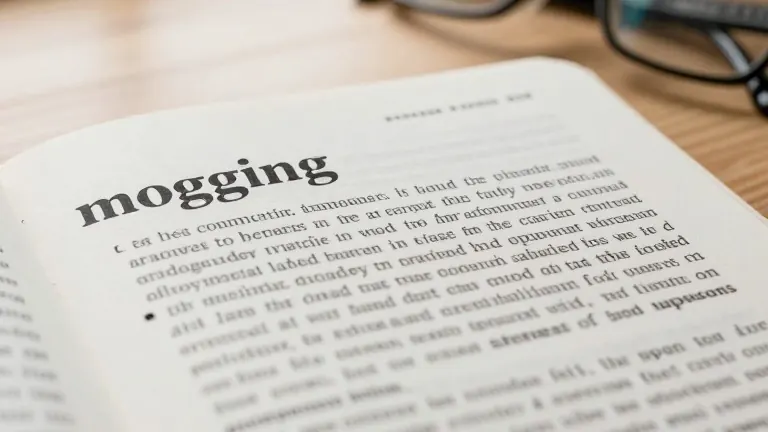
Collins has selected "mogging" as its word of the year for 2026. The term describes the act of making someone or something appear inferior in appearance, confidence, or status. Copywriter Rachel Quin announced the winner in a published article for the dictionary.
Quin stated that the word likely originated as a shortening of "Amog," a term referring to the alpha male of a group. It first appeared in bodybuilding culture around 2016 before spreading through online communities. By this year, the expression had become common in everyday slang.
"Teenagers mog elite athletes, a new video game mogs an old favourite, and your friend’s sourdough mogs the loaf you spent all weekend proving," Quin wrote. She explained that if someone or something makes you look bad by comparison, you have been mogged. Quin described the overall shortlist as feeling like one large contest of outperformance.
The other shortlisted terms covered various sectors, including transport, politics, and the climate. "Carspreading" made the list, describing the trend of manufacturers building longer, wider, and heavier vehicles. Quin noted that sport utility vehicles accounted for more than half of new car sales in 2025. This shift has resulted in tighter parking bays and narrower country lanes.
Political language on the list was dominated by "Manchesterism." This term refers to the philosophy of Prime Minister Andy Burnham, which focuses on devolving regional power while combining economic growth with social progress. Burnham revived the 19th-century term in a newspaper article in January. He replaced Keir Starmer as prime minister in July. Quin observed that Burnham’s supporters hope the strategy used in Greater Manchester will work for the entire country, though critics still question its specific meaning.
Environmental and job market terms also featured in the selection. "Firewave" describes multiple wildfires breaking out during a short dry spell, a term coined by Imperial College London researchers in 2025. "Ghost job" refers to positions advertised by employers with no intention of hiring. A recent UK study found that around a third of advertised roles were ghost jobs. Quin called this recruiter behavior a new low.
Additional entries included "friendslop," a term for low-budget multiplayer indie games, and "bixie," a hairstyle blending a bob and a pixie cut. The list also contained "P(doom)," a mathematical shorthand for the likelihood of artificial intelligence causing civilizational collapse. Quin concluded that while 2026 was defined by competition, the lexicon also showed how society adapted.
Quin said resilience and fun could be the keys to winning through. The announcement reflects a year where distinct terminology emerged for specific social, economic, and environmental phenomena.
Source: The Guardian