South Korean defense firms face drone shift as shares slide
Falling share prices and changing military priorities are testing South Korea’s defense industry, even as analysts see lasting demand for its conventional weapons.
By News Media House Staff ·
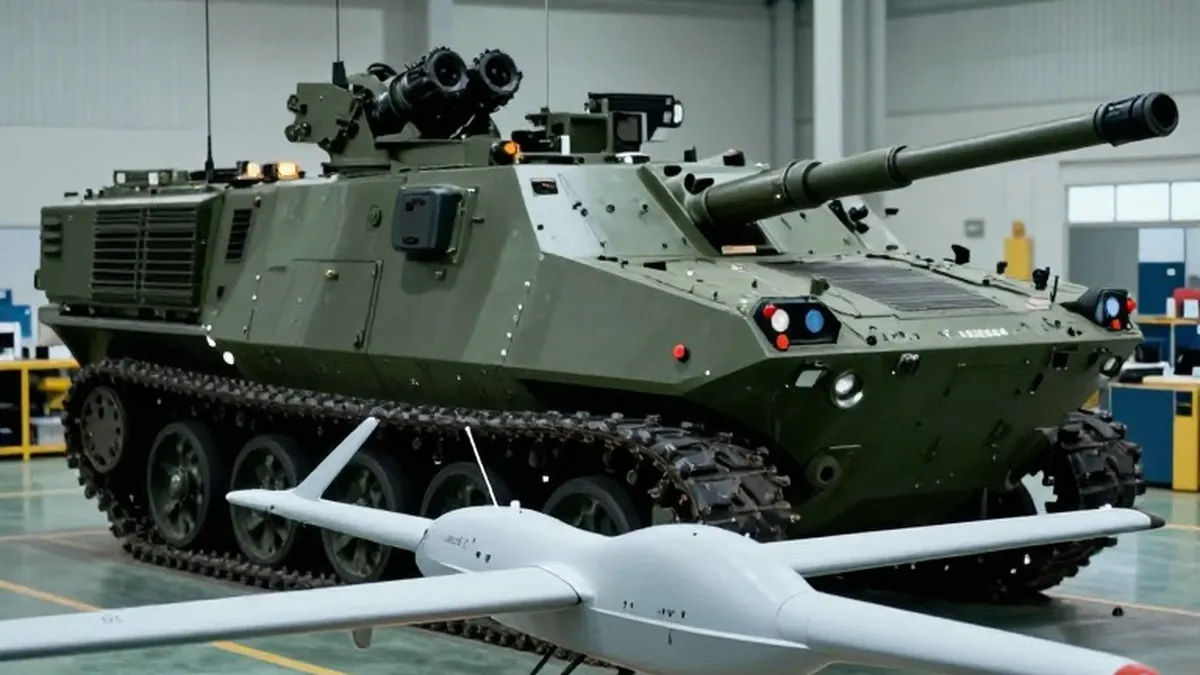
South Korea’s defense companies are facing a sharp reversal in their stock market fortunes as investors assess weaker earnings, delayed export orders and changes in military procurement. After benefiting from two years of global rearmament, manufacturers known for tanks, artillery and missile systems must also contend with growing demand for drones and defenses against them.
The combined market capitalization of Hanwha Aerospace, LIG D&A, Hyundai Rotem and Korea Aerospace fell to roughly 62 trillion won, or $46.18 billion, by the end of October, according to South Korean broadcaster SBS. That compares with a 52-week peak of 170 trillion won. The earlier rally followed increased European military spending after Russia’s invasion of Ukraine, with South Korean suppliers attracting customers through competitive prices and relatively fast deliveries.
Battlefield developments have raised questions about how those companies will adapt. In Ukraine, relatively cheap drones have demonstrated their ability to threaten expensive equipment. Iranian drone strikes have also drawn down supplies of costly air defense missiles held by the United States and its Gulf allies. Bank of America analyst KJ Hwang said procurement priorities were moving toward drones, counter-drone systems and air defense. Peter Kim, senior managing director at KB Securities, said China’s dominance in drones was pricing out potential competitors.
Other pressures have contributed to the share declines. Investors are weighing disappointing financial results, a stronger won and export delays. Kim also pointed to investment flows into semiconductors and high defense stock valuations that depended on strong earnings growth. Governments, he said, have been slower than anticipated to turn spending commitments into approved budgets and contracts.
Hanwha Aerospace reported a third-quarter operating profit decline of more than 46% from a year earlier, citing delivery-schedule changes and one-off expenses. Its shares have lost more than 28% this year. Hyundai Rotem’s operating profit dropped more than 11.1%, while its stock has fallen almost 60%. Korea Aerospace Industries posted increases of about 52% in quarterly sales and 32% in operating profit, with its shares down just over 8% this year.
Analysts nevertheless see support for longer-term demand. Hwang cited expanding cooperation with Western European and Middle Eastern partners, including on air defense, alongside further K9 howitzer orders. This year’s contracts include approximately 546 million euros in K9 orders from Spain and a $922 million Norwegian order for K239 rocket systems, both involving Hanwha Aerospace. LIG D&A secured a $94 million Malaysian deal for its K-SAAM naval missile system, its first export sale.
Quantum Strategy strategist David Roche told CNBC that military orders increasingly emphasize artificial intelligence and drones, but conventional forces remain necessary to seize and hold territory. South Korean manufacturers are also investing in drones and unmanned systems. Kim expects potentially clearer results in the near future, although substantial exports will take time because foreign buyers require evidence of operational performance.
Originally published by News Media House · Source: CNBC
More News · National news · Report a business · Got a Story?