South Korea Trials Arctic Shipping Shortcut to Europe as Russia Tensions Simmer
A South Korean container ship's round trip from Busan to Rotterdam via the Northern Sea Route has raised hopes in Seoul for faster trade, but also concerns among Western allies wary of closer ties with Moscow.
By News Media House Staff ·
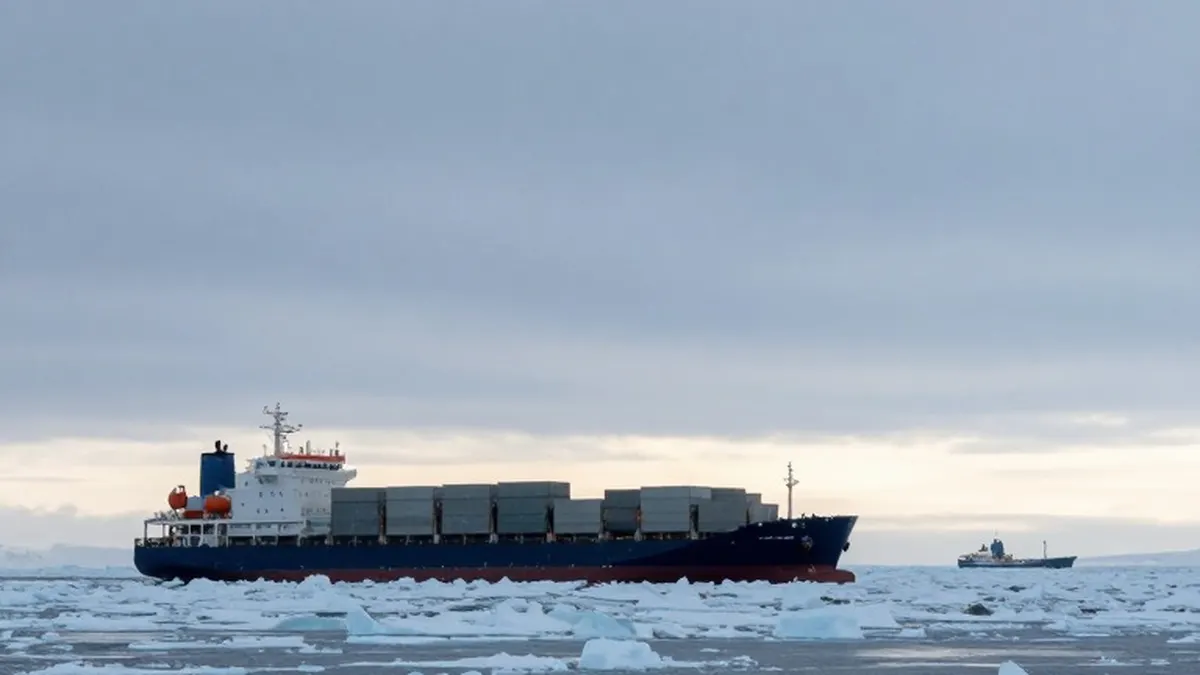
A South Korean container vessel has completed a voyage to Western Europe through the Arctic Ocean along Russia's northern coast, a journey made in October that has strengthened Seoul's ambitions of developing the passage into a trade shortcut.
The ship traveled from Busan to Rotterdam and back in only 50 days, cutting at least 10 days off the quickest journeys through the Suez Canal. The Northern Sea Route, or NSR, is roughly 7,000 kilometers, or 4,350 miles, shorter and also steers clear of the geopolitical instability of the Middle East.
Yet the prospect of quicker deliveries is unlikely to be welcomed in every Western European capital. Analysts say governments opposing Russia over its invasion of Ukraine worry that South Korean President Lee Jae-myung is seeking to deepen economic ties with Moscow, which would cut against the efforts of Kyiv and its allies to isolate Russia.
The economic appeal is one clear motivation, but analysts told DW that Seoul also believes a functioning relationship with the Kremlin could help persuade President Vladimir Putin to hold back on supplying additional weapons to North Korea. They say Lee's government will have to steer through the geopolitical risks with great care.
The container ship PanStar Acro departed Busan on August 22, sailed around Russia to the British port of Felixstowe, then called at Rotterdam in the Netherlands and Gdansk in Poland before returning along the NSR. Long blocked by polar ice, the route is becoming navigable as climate change shrinks the ice cover, though commercial vessels often still require icebreaker escorts at certain times of year.
The Arctic Council, whose members include the United States, Russia, Canada, Norway, Sweden, Finland, Denmark and Iceland, recorded a high of 1,812 vessels operating in the Arctic last year, a 40 percent rise compared with 2013. Lee's government has set out plans for regular commercial NSR services by 2030, treating the first Korean crossing as a logistics test.
"In addition to potentially lowering shipping costs and transit times, the route's development could strengthen Busan's position as a regional maritime hub and create opportunities for South Korea's shipbuilding sector," said Joseph Kristanto, a maritime security analyst at Singapore's S. Rajaratnam School of International Studies. He cautioned, however, that reliance on the route could create a new strategic dependency because Moscow tightly controls navigation along its Arctic coast, potentially using regulations and "the provision of icebreaker assistance" as leverage.
"From the European perspective, closer economic engagement with Russia risks undermining efforts to isolate Moscow over its invasion of Ukraine," Kristanto said, noting that diplomats' concerns also extend to the alleged delivery of about 165,000 tons of fuel to Russia in August aboard sanctioned Russian tankers. All of this comes as North Korea, Seoul's archrival, is sending troops to support Russia's war effort.
Andrei Lankov, a Russian-born professor of history and international relations at Seoul's Kookmin University, said the route "makes perfect economic sense" and that Seoul is "trying to send signals to the Russian government that it is willing to manage relations." He linked this to Seoul's sharper stance toward Kyiv since September, when a dispute over President Volodymyr Zelenskyy's disclosure that two captured North Korean soldiers had been transferred to South Korea escalated into a diplomatic spat, with Seoul demanding apologies and pulling some diplomats from Kyiv.
Lankov suggested the row may have been partly calculated, allowing Lee's administration to resist pressure to aid Ukraine materially while signaling goodwill that Moscow could repay by withholding advanced military technology from Pyongyang. "Right now, South Korea wants to fly under the radar, to examine the possibilities and be prepared for when the war is over, and sanctions on Russia are lifted in the future," he said. Kristanto expects Seoul to "pursue a cautious and incremental approach," adding: "Ultimately, South Korea is not necessarily choosing between Russia and the West, but attempting to preserve a potentially valuable economic opportunity without compromising its more fundamental strategic relationships."
Originally published by News Media House · Source: Deutsche Welle