
Russia completes massive radar base in Kaliningrad near Poland
The new facility, which extends 500 meters in three directions, is designed to monitor air and sea traffic across 3,000 kilometers of European territory.
By Chloe Wilson ·
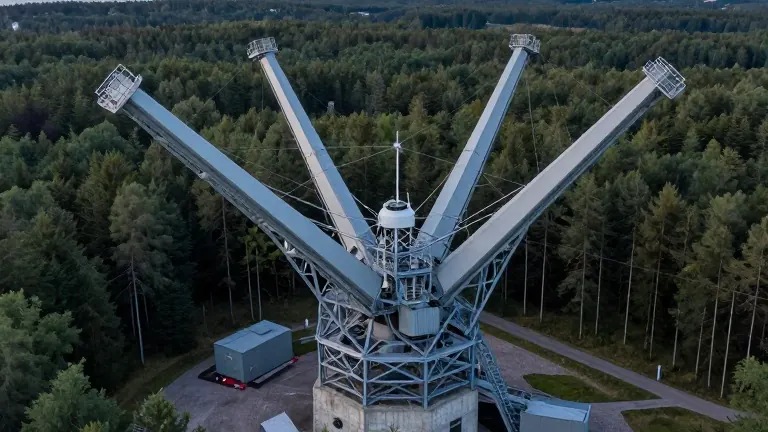
Construction of a large radar complex in Russia's Kaliningrad region is nearly finished, placing a new surveillance system on the borders of Poland and Lithuania. The facility, located near the town of Gvardeysk, consists of three arms, each exceeding 500 meters in length. When viewed from above, the structure appears as a massive object set within a forested nature reserve.
Security experts indicate the system is an over-the-horizon radar capable of seeing beyond the curvature of the Earth. Vaidotas Malinionis, a retired Lithuanian commander, stated the network will have a surveillance range of approximately 3,000 kilometers. This range allows Moscow to monitor most of Europe and Ukraine. The system is reported to be able to intercept satellite communications and detect aircraft and ballistic missiles.
The development follows a long period of military buildup in the exclave. Russia has not officially confirmed the construction of the new radar, but satellite imagery and local reports confirm the work is underway. The Times, citing data from the Finnish-Polish firm ICEYE, reports the system is intended to detect and jam electronic signals. Malinionis noted that the radar provides early warning capabilities, giving military commanders more time to make decisions if NATO troops move near the eastern frontier.
Analysts warn the new technology could reduce the effectiveness of drone integration in regional defense. Evija Djatkovica, a Latvian geopolitical analyst, said the radar helps Russia close loopholes in detecting low-flying objects. She described Kaliningrad as becoming a hub for advanced military sensors and electronic warfare. Djatkovica noted that the expansion intensifies the contest for control of the region between Russia and NATO.
The Kaliningrad region is a small exclave, measuring only 200 kilometers from west to east and 100 kilometers from north to south. Despite its size, it holds strategic importance. Malinionis said some sources indicate Russia has the capability to deploy up to 100 nuclear warheads in the area. He added that some reports suggest deployments have already begun, though this has not been confirmed by Moscow.
New satellite images show additional military infrastructure in the region. The Frankfurter Allgemeine Zeitung reported that ICEYE discovered a large circular antenna complex near Chernyakhovsk, about 50 kilometers west of Gvardeysk. More than 20 signal and electronic warfare facilities are located throughout the region. Images also reveal new shelters for fighter jets at the Kaliningrad-Chkalovsk airfield and launch pads at an S-400 missile site in Baltiysk.
The West is responding with new technologies to counter these developments. Germany is building Synthetic Aperture Radar satellites in partnership with ICEYE. These satellites will provide precise images of troop movements for NATO units on the eastern flank. The first of these satellites are scheduled to launch into orbit on a SpaceX rocket in early 2027. Malinionis observed that while the Russian radar is a powerful tool, its large size makes it a visible target for opposing forces.
Source: Deutsche Welle